SDGs promotion
attempt■ President's Declaration
Kyushu Sangyo University × SDGs
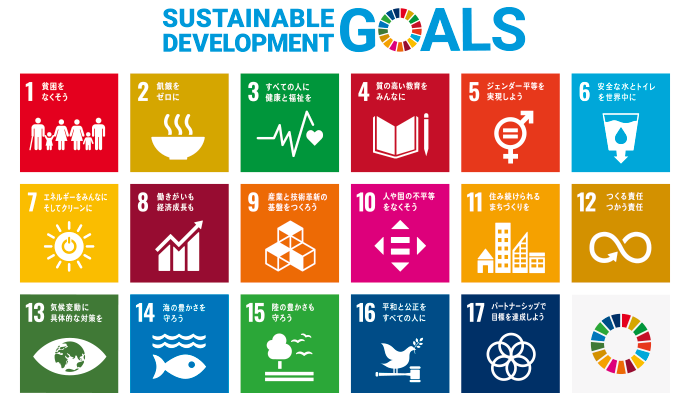
Poverty, conflict, climate change, infectious diseases... Humanity is currently facing numerous issues that must be resolved. Against this backdrop, the Sustainable Development Goals (SDGs) were formulated at the United Nations Summit in 2015, clarifying the global goals to be achieved by 2030 to resolve various social issues.
Kyushu Sangyo University has established the "President's Declaration" to position activities toward achieving the Sustainable Development Goals (SDGs) as a university-wide initiative and to further accelerate it.
President's Declaration
"Kyushu Sangyo University University declares that it will promote the SDGs and nurture SDG leaders."
Kyushu Sangyo University SDGs Promotion Policy
- Promote research that integration of humanities, sciences, and arts, and work to solve social issues
- Collaborate with local communities and industries to contribute to the development of local communities and solving their problems.
- Raise awareness of the SDGs and develop human resources who can take action to realize a sustainable society.
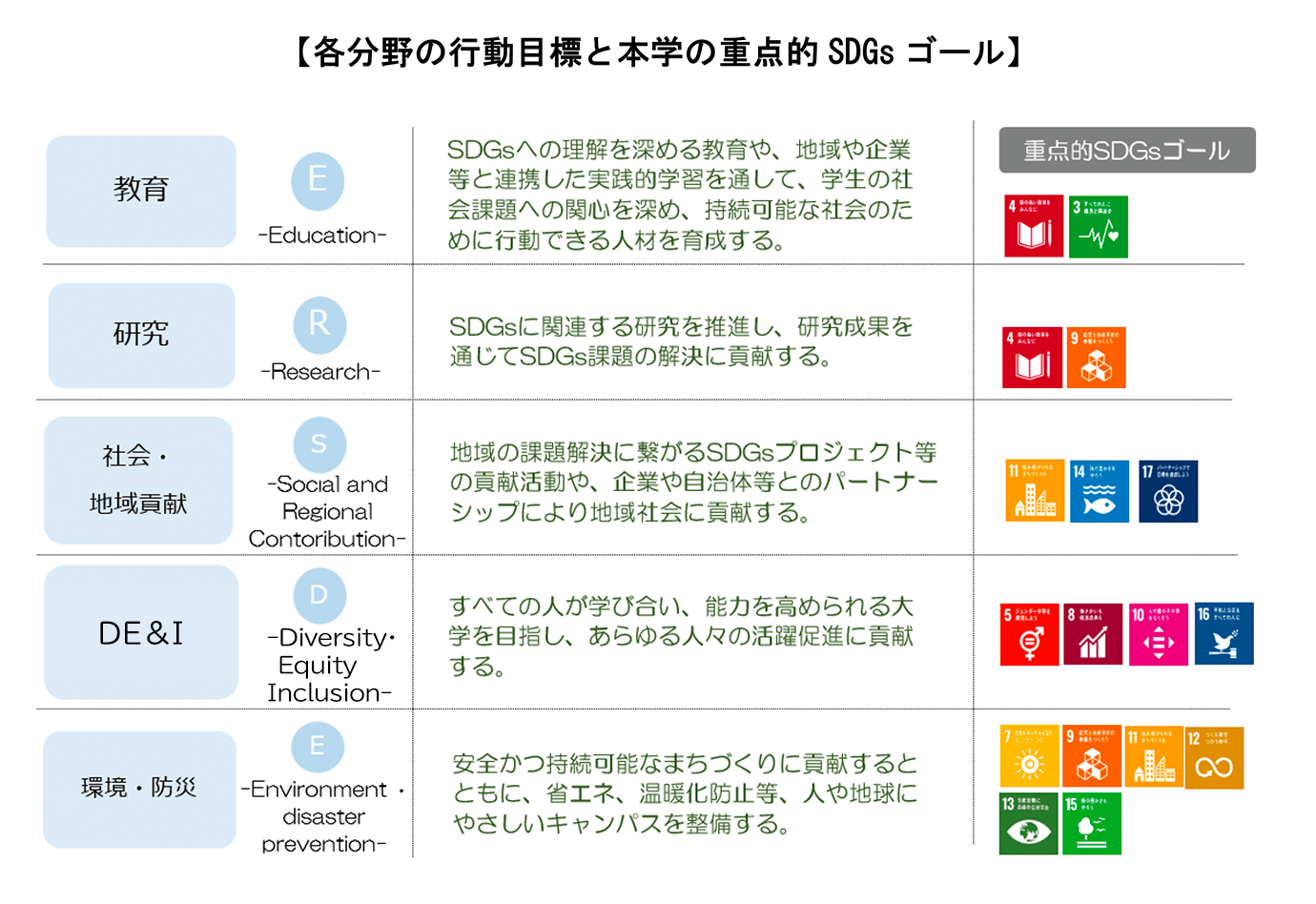
Based on this declaration, in April of this year, our university will launch a new integration of humanities, sciences, and arts course themed on the SDGs, "Practical Interfaculty Collaborative Course (SDGs)." In addition, we will categorize our SDG-related activities, such as the "KSU Project-based Education" we have promoted with companies and local governments, and global education in collaboration with the UN-Habitat Fukuoka headquarters, into five areas: "Education," "Research," "Contribution to Society and the Community," "DE&I," and "Environment and Disaster Prevention." We will set action goals in each area and strengthen our efforts, in an effort to cultivate the next generation of leaders who will contribute to the achievement of the SDGs.
■Education
Educational Programs x SDGs
●Starting in the second semester of 2022, we will be offering a integration of humanities, sciences, and arts course, "Practical Interfaculty Collaborative Course (SDGs)"!
As a course subject in the second semester of the first year, we will offer an omnibus-style "Practical Interfaculty Collaborative Course (SDGs)" taught by lecturers from the humanities, science and engineering, and arts faculties. Students will systematically learn about the SDGs through a variety of fields, including community development, economics, business management, information, housing, and design.
● Enhancing "KSU Project-based Education"

This is an educational program that takes students out of the classroom and into the real world, where they learn while finding answers. By collaborating with local communities, businesses, and government agencies to launch and work on projects, students learn about the field, take action on their own, and develop the ability to derive answers. We have developed 90 projects that transcend the boundaries of faculties and departments, including product development and promotion, technology development, and event hosting through industry-academia-government collaboration, and we plan to further expand our collaborations and enrich our programs in the future.
● Promoting "KSU-COIL Program"
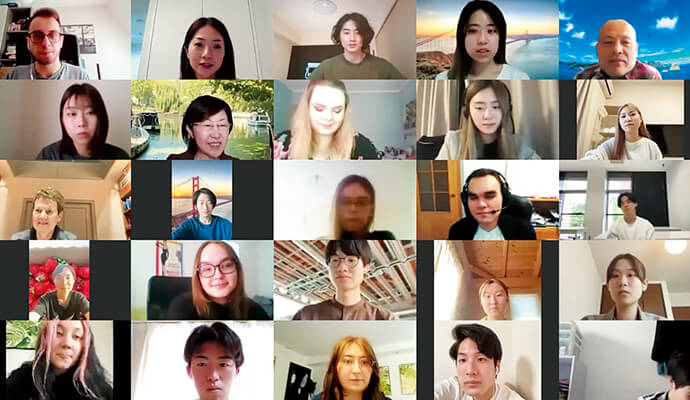
We have developed our own unique "KSU-COIL Program" centered on Collaborative Online International Learning (COIL), which is attracting attention as a new educational method for international exchange with overseas universities, and are promoting it as part of our distinctive global education.
Through overseas study and language training in the Global Leadership Program(GLP) (GLP), a special interdisciplinary educational program, we aim to cultivate the next generation of leaders who will be active on the world stage and contribute to achieving the SDGs.
●Joint summer school held with Fukuoka Women's University to consider environmental issues

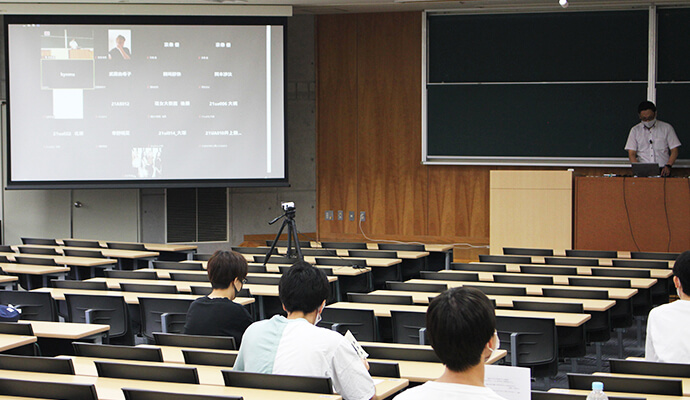
From Thursday, August 26th to Tuesday, August 31st, 2021, we held a joint summer school where we learned with students from Fukuoka Women's University.
This summer school has been held since 2020, and this was the second time it was held, with 38 students from both universities taking lectures mainly online, with the theme of "Considering various environmental issues in Kyushu and Fukuoka from the perspective of consumers."
The lectures considered environmental issues from various perspectives, including air pollution and renewable energy, and on the final day, Hiroko Yamamoto, representative of the citizens' group "Washiro Tidal Flats Protection Association," took the stage as a guest speaker to introduce her group's efforts.
●Participate in the worldwide coastal garbage survey
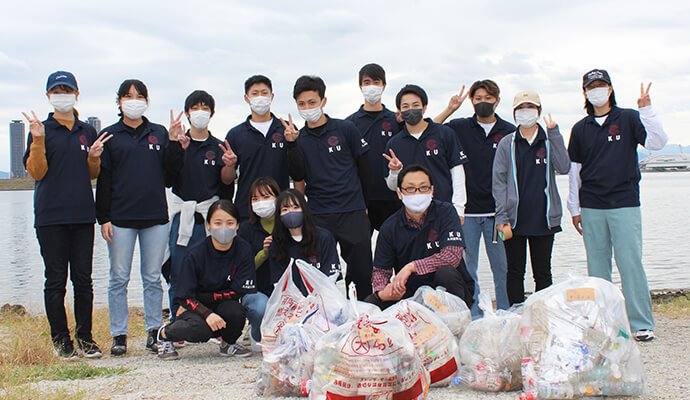
On Thursday, October 21, 2021, 13 students from Professor Munakata Masaru's seminar Department of Regional Development Faculty of Collaborative Regional Development Faculty of Regional Co-Creation, conducted a garbage survey at Ganosu Beach as part of the International Coastal Cleanup.
The International Coastal Cleanup is a survey of coastal garbage that is carried out at this time every year in around 100 countries and regions around the world in response to an initiative by the American environmental NGO Ocean Conservancy. The Munakata Seminar has been conducting surveys at Gannosu Beach since 2012.
After collecting the garbage for an hour, the students re-sorted it into the 45 categories defined by the NGO and tallied the number of pieces of each type. There is a lot of garbage on Gannosu Beach that has washed down from the river, and in this year's survey, in addition to plastic bottles and food packaging bags, masks to protect against COVID-19 were also found.
■Research
Children × Exercise × SDGs
●Increase your activity by making it visible!

Physical activity is said to be related to 13 of the 17 goals, including Goal 3 (Good Health and Well-Being).
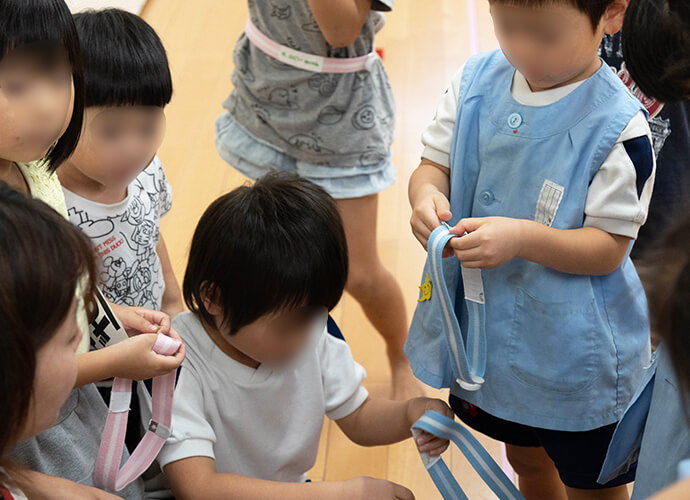
Associate Professor Saori Tanaka of the Department of Department of Childhood Education Faculty of Human Sciences, has collaborated with a company to develop a physical activity monitor for young children, working to make the amount of physical activity visible. In kindergartens and daycare centers, children are fitted with an activity monitor to measure the amount and quality of their daily activity, visualize the data, and provide it to parents and caregivers. It is expected that the results will lead to improvements in the quality of education and childcare, such as encouraging families to increase the amount of time they spend playing and moving around on weekends, and for daycare centers to understand individual differences in the amount of physical activity and use this information to provide support in the future.
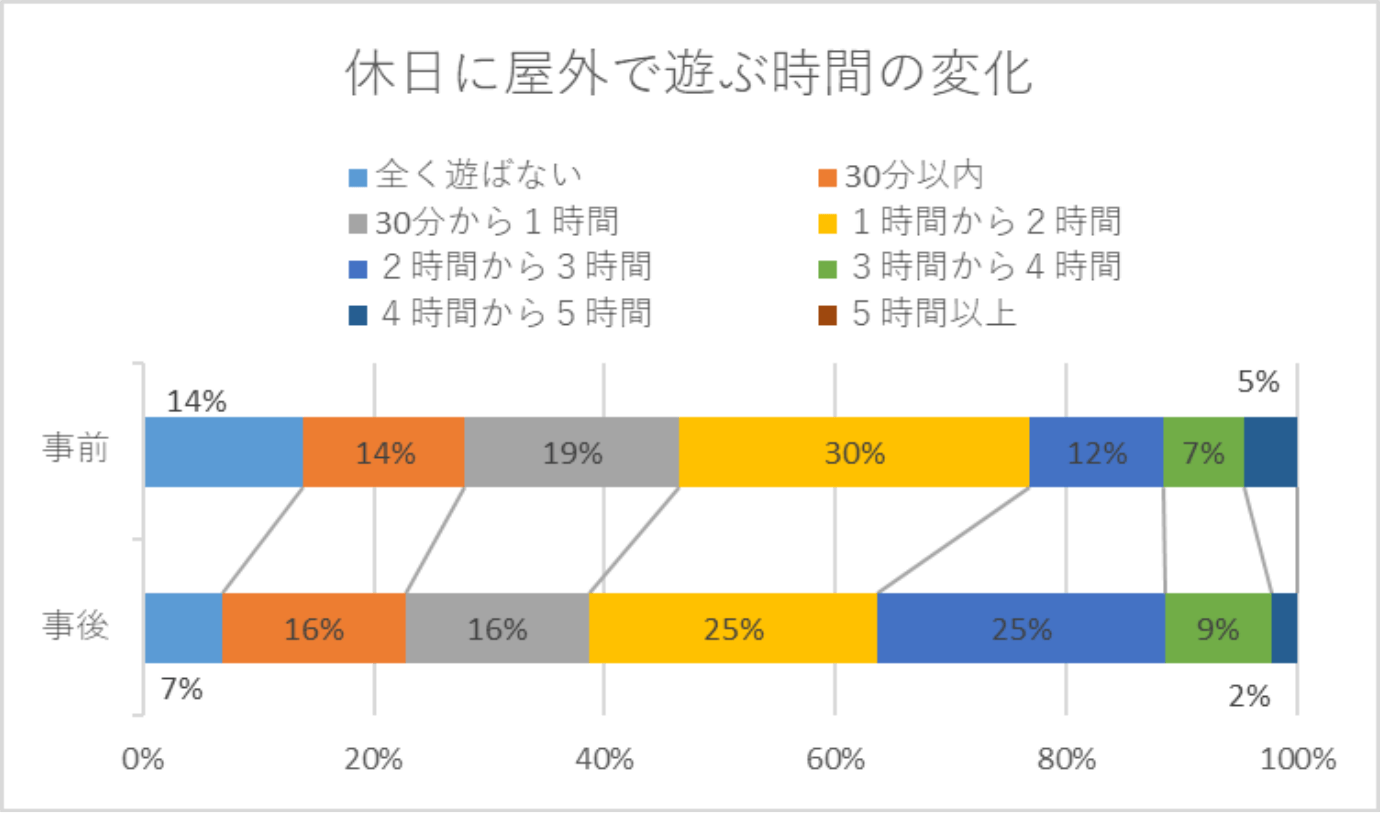
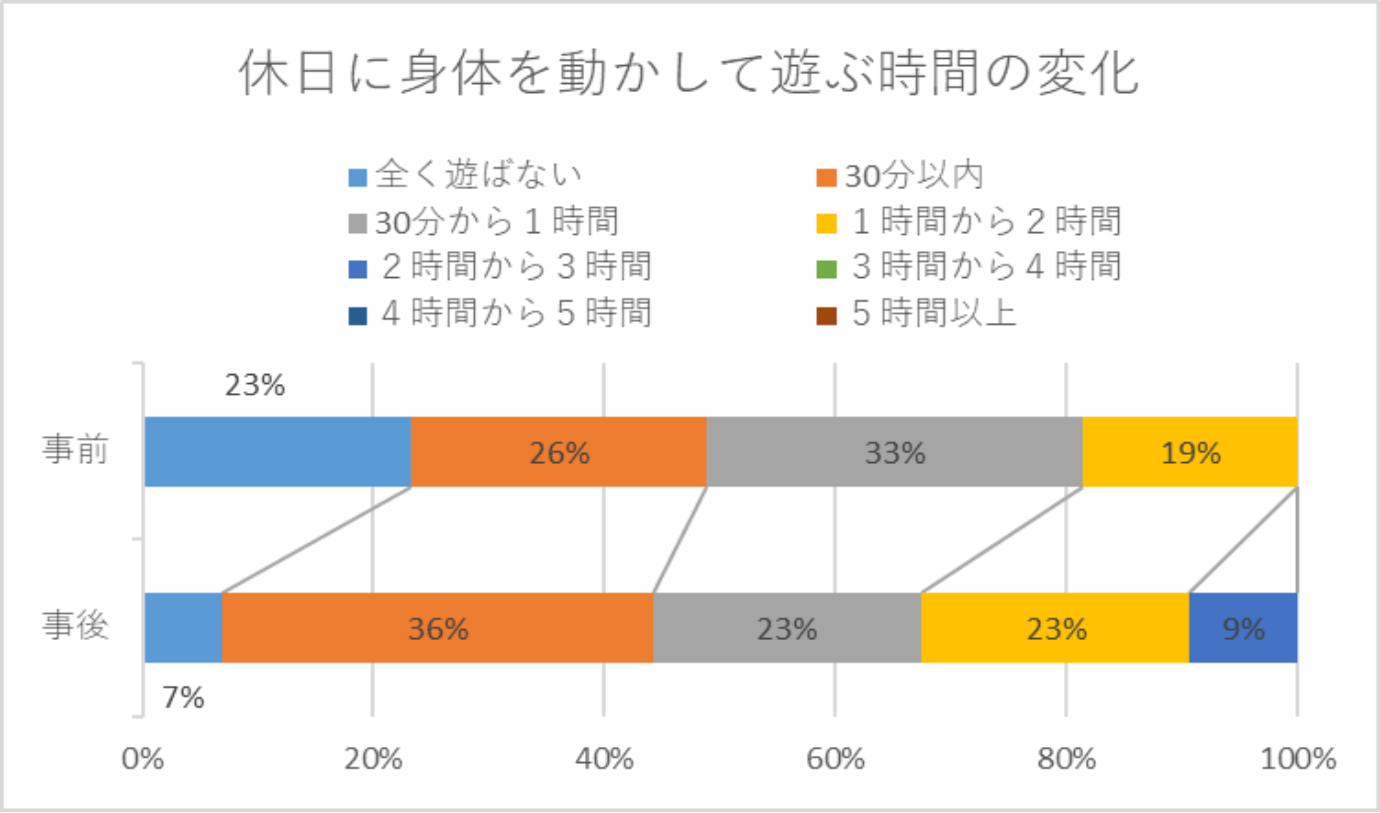
- Survey period: 32 days from August to September 2019
- Survey subjects: [Physical activity measurements] 4-year-olds (31 people) and 5-year-olds (23 people) attending certified childcare facilities
[Survey on awareness of physical activity] Parents of children
University Sports x SDGs
●Proof that sports and SDGs go well together!
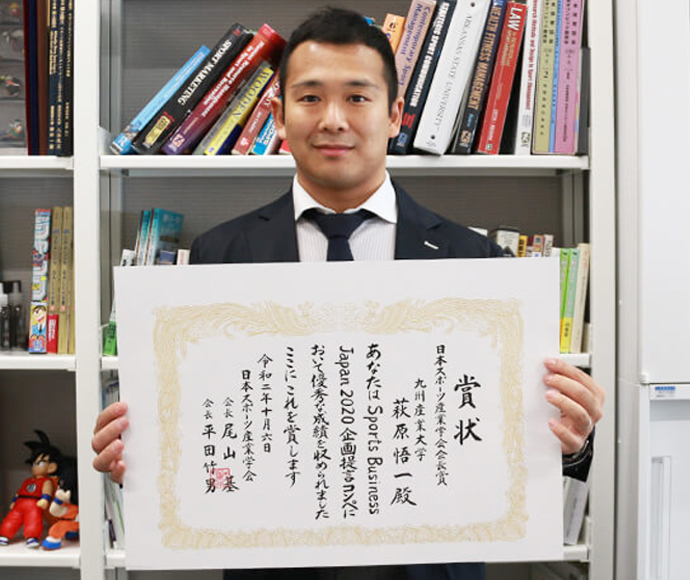
One proposal that has received high praise for combining university sports with the SDGs is "Promoting ESG investment in sports: Considering university sports resources as an example," by Associate Professor Goichi Hagiwara of the Department Department of Sport Science and Health Faculty of Human Sciences.
The project involves conducting a comprehensive survey of universities covering their degree of achievement of the 17 SDGs, including environmental value, social value, and governance systems, and creating a "Sports SDG Ranking" based on the results. It also aims to match companies with universities using ESG investment *.
This proposal won the Sports Industry Society President's Award at the Sports Business Japan 2020 Planning Proposal Competition, which selects outstanding sports policies aimed at revitalizing the sports industry, and was highly praised for proving the compatibility between sports and the SDGs and for combining ESG investment.
In the future, it is planned to use this proposal to strengthen ties with the Japan University Sports Association (UNIVAS), and it is expected that this will lead to further contributions to the university sports world.
*ESG investment...
This refers to investment that takes into consideration not only traditional financial information but also environmental, social, and governance factors, and is attracting attention as it will provide a concrete direction for corporate management that incorporates elements essential to achieving the United Nations Sustainable Development Goals (SDGs).
This refers to investment that takes into consideration not only traditional financial information but also environmental, social, and governance factors, and is attracting attention as it will provide a concrete direction for corporate management that incorporates elements essential to achieving the United Nations Sustainable Development Goals (SDGs).
■Contribution to society and the community
Volunteering and SDGs
● Cleaning activities to achieve "zero marine litter"
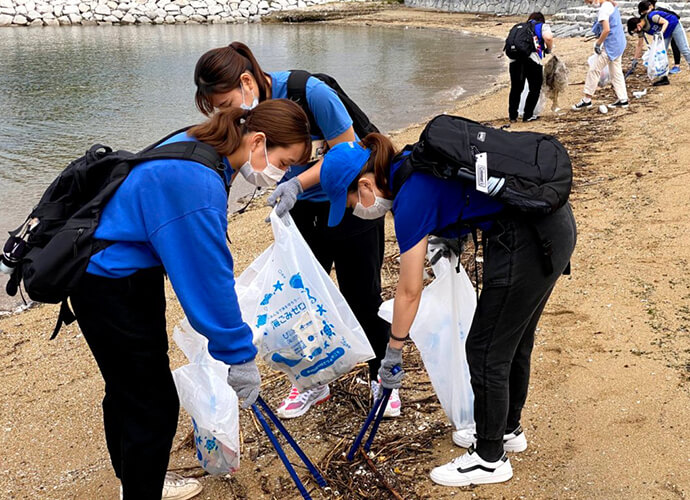
On Friday, June 25, 2021, 22 students and four faculty and staff members from the volunteer club cleaned up marine debris at Kashiihama Beach, and on Saturday, June 26, 35 students and four faculty and staff members cleaned up marine debris at Najima Beach.
The event was organised by a group of volunteers who support the "Zero Marine Litter Initiative" being promoted by the Ministry of the Environment and the Nippon Foundation with the aim of solving the ever-increasing problem of marine litter around the world and raising awareness of the need to avoid producing marine litter. On the day, a large amount of marine litter was picked up by hand.
Board games and SDGs
● Make social issues your own through board games
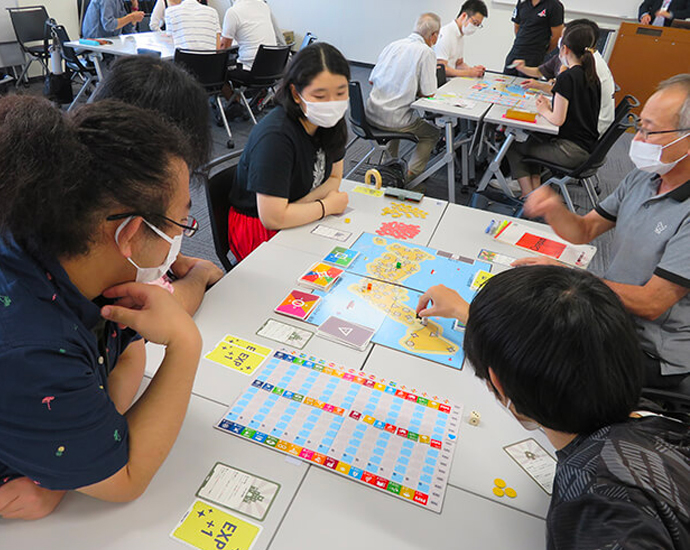
On Saturday, October 9, 2021, our university held an open lecture for local residents, "SDGs Board Game: Making Social Issues Your Own Problem." Through the board game, 14 participants had fun learning about examples of solving global issues related to the SDGs, and also reaffirmed the importance of partnerships.
■ DE&I
Career × Diversity × SDGs
●Supporting students' careers through programs that consider diverse lifestyles
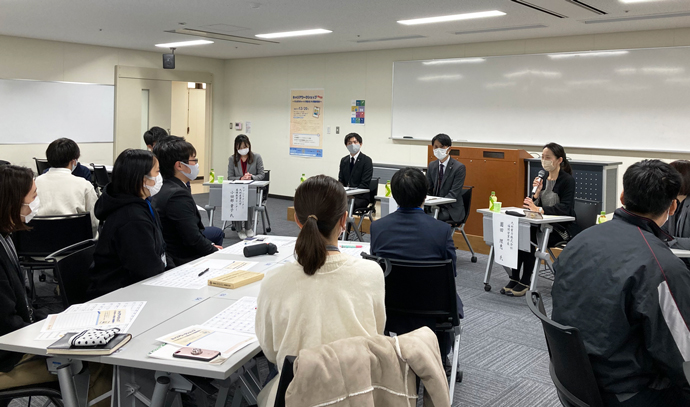
In collaboration with the Gender Equality Promotion Office (now Diversity,Equity and Inclusion Office), Career Support Center held a "Career x Diversity Lecture" on Friday, November 26, 2021, and a "Career Workshop - Thinking about yourself 10 years from now using a Mandala Chart" on Monday, December 20, for students of all years.
As part of career support that takes into account life plans and work styles, a lecture was given by a lecturer from the Fukuoka Labor Bureau on work rules (labor laws) that guarantee diverse work styles. In addition, a panel talk was held in which guests from outside the university and faculty and staff shared their experiences of balancing career paths and work with childcare, and a workshop was held to clarify one's vision for the future using a goal achievement sheet called a Mandala Chart.
The students considered the significance of working in a way that suits them through diverse lifestyles and career designs, and learned that being proactive can lead to further career fulfillment.
■Environment/disaster prevention
Okusu Arena 2020 x SDGs
● A sustainable "Okusu Arena 2020"

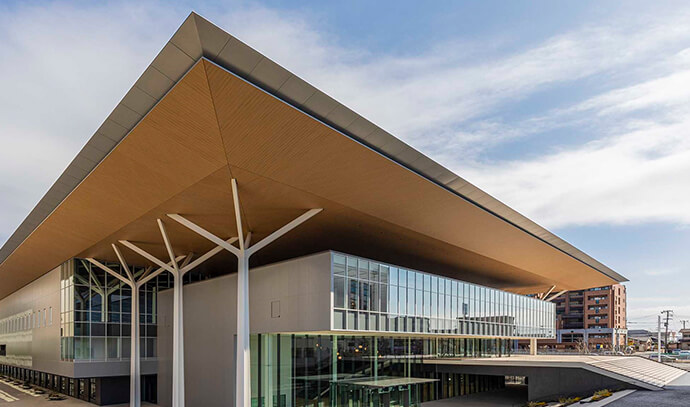
Okusu Arena 2020 is an economically and environmentally friendly facility that employs passive design, a design technique that creates a comfortable space by making maximum use of natural energy such as solar heat, light, and wind without putting a burden on the earth.
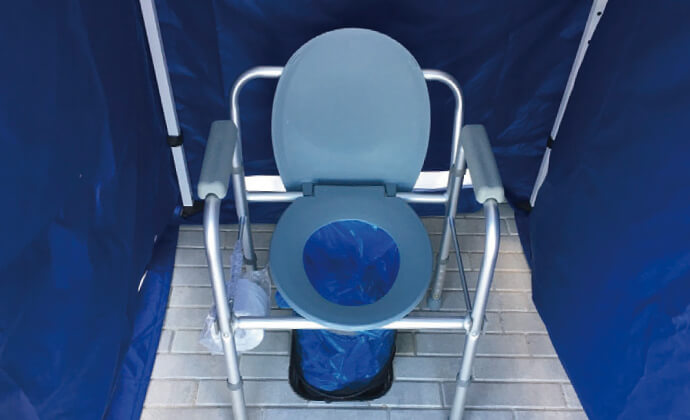
In addition, around the arena, there are "manhole toilets" that can be opened to create temporary toilets by opening a manhole that is directly connected to the emergency drainage tank in the event of a sewer pipe rupture, and "kamado benches" that can be used as stoves for cooking food by removing the seats. The arena also has a stockpile of various disaster prevention supplies so that it can be used as an evacuation shelter for local residents in the event of a disaster.


If you cannot view PDF files, please download Adobe Reader.