
Preventing campus harassment
attemptTowards a safe and fair campus
- Kyushu Sangyo University and Kyushu Sangyo University, Zokei Junior College of Art and Design are committed to creating a campus where harassment of any kind is not tolerated, so that all members can study and work in a safe and fair environment.
- If you think you may be experiencing harassment, please contact the consultation desk.
The privacy of those seeking advice and those involved will be strictly protected, so please feel free to contact us.

What is harassment?
Campus harassment refers to harassment perpetrated by those in a stronger position against those in a weaker position within the various interpersonal relationships at university.
Academic Harassment
Harassment through the use of power in research and education settings
- Example: After I turned in a report, I was yelled at, told "You have no talent, so you should just quit," and "Your work is at the level of a middle school student."
- Example: My research has been hindered. Or, I have not been given any guidance.
- Example: I was forced to do odd jobs that were unrelated to teaching or research.
Sexual harassment (environmental type)
Deteriorating the environment for studying, working, receiving education, or conducting research through sexual remarks or actions
- Example: Teachers keep asking me questions like, "Do you have a boyfriend? Do you stay over at their house?"
- Example: Obscene photographs, posters, etc. are posted in research labs or club rooms.
- Example: Repeatedly making sexist remarks during class.
Sexual harassment (quid pro quo)
Offering some kind of benefit or disadvantage in exchange for complying with or refusing sexual advances
- Example: After I refused a date invitation, I was forced to rewrite my thesis more times than necessary.
- Example: When I asked for a letter of recommendation, the person persistently asked me if I wanted to go out to dinner.
- Example: I was forced into a sexual relationship in exchange for being given priority in employment.
Sexual harassment (gender harassment)
Making discriminatory remarks and actions based on stereotyped gender roles
- Example: A teacher told me, "You're not a man if you can't get a proper job and support your wife and children."
- Example: When I consulted my professor about going to graduate school, I was told, "Women aren't suited to research, so you'd be better off giving up."
- Example: Female students are always the ones who are given the chores in the seminar.
Sexual harassment (abuse of status)
Using a superior position to make sexual requests or advances
- Example: You receive frequent phone calls or are called to the lab in the name of providing guidance on your graduation thesis.
- Example: Teachers or senior students approach or touch you in an unnatural way during sports or computer lessons.
- Example: At a party, you are forced to sit next to someone or be forced to pour drinks or sing a duet.
Power harassment
Inappropriate verbal or physical actions, guidance, or treatment that goes beyond the scope necessary for business and that discourages the other party from working, or that deteriorates the educational/research environment or working environment, etc.
Harassment regarding childcare leave, etc.
Unfair treatment, verbal or physical actions, or other disadvantages or benefits due to pregnancy, childbirth, childcare, or elderly care, etc., that deteriorate the educational/research environment or working environment, etc.
Other forms of harassment
Any other inappropriate behavior that goes against the will of the other party and is perceived as unpleasant by the other party, whether intended or not, causing various disadvantages to the other party, discomfort, threats, or humiliation, and worsening the educational/research environment or working environment, etc.
Why does campus harassment occur?
- 1. Power relationships within the university organization
- There can be unequal relationships between faculty and students, seniors and juniors, majority and minority, and men and women.
In particular, teachers have extremely strong influence over students in terms of credit recognition and evaluations for further education and employment. - 2. Closed nature of university organizations
- "University autonomy" and "academic freedom" are guaranteed, and external interference is excluded, which means that these types of issues tend to become extraterritorial.
- 3. Sexual discrimination and gender role division
- Due to gender differences, there is a lack of awareness of men and women as equal partners in education, research, and work. There is a misconception that men and women are fundamentally different and have different roles.
- 4. Insensitivity to other people's feelings
- There is a lack of sensitivity to how one's words and actions affect others.
What if I commit harassment?
Severe campus harassment will be subject to disciplinary action.
Let's each be fully aware and act accordingly.
How to deal with campus harassment
If you are a victim...
Don't blame yourself. It's not your fault. It's the fault of the perpetrator and the people around you who overlooked it.
- 1. Tell them you don't want to
- If possible, tell the other person that you don't like it. They may not be aware of your feelings. If you can't say it by yourself, ask for help from people around you.
- 2. Don't deal with it alone
- Don't suffer alone, talk to a friend or someone you can trust. The counselors at your university's counseling center will also be there to help you.
- 3. Keep records
- If possible, keep a record of when, where, who did what and who said what to you.
Whenever possible, keep records of phone calls, emails, etc.
If you see a friend or acquaintance being affected...
- 1. Provide counseling to victims
- Listen carefully to the victim and show that you understand their suffering. Never blame the victim. This will only cause secondary victimization for the victim who is already suffering.
- 2. Recommend consulting a consultation center
- Encourage them to seek advice from a counseling center, and if possible, accompany them there.
Counsellors are bound by confidentiality.
Please feel free to contact us as your privacy will be strictly protected.
Things you should keep in mind on a daily basis...
- 1. Be mindful of valuing each individual
- Regardless of age, gender, or position, be mindful of respecting the position of others.
Let's stop making assumptions like "because she's a girl," "because she's a boy," or "because she's a junior." - 2. Take responsibility for your own actions and words
- Be aware of the power you hold and be sensitive to the impact you have on others.
- 3. Develop healthy assertiveness
- A style of communication that respects both oneself and others, where one honestly expresses one's thoughts and feelings to others
Let's learn it.
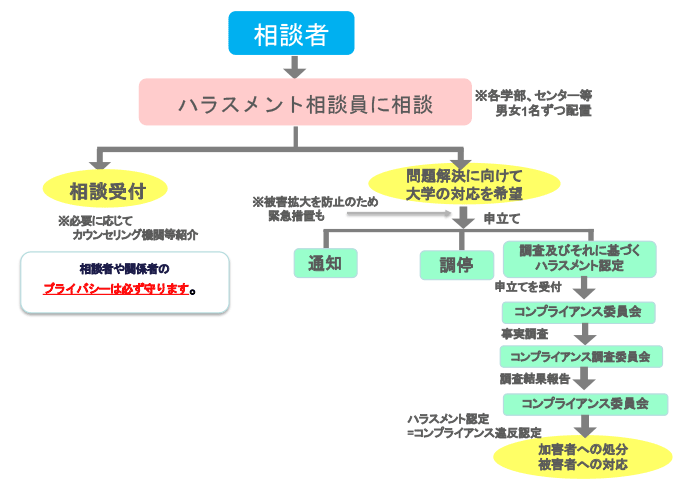
Harassment consultation process
- Victims can receive support from harassment counselors whether or not they file a complaint with the university.
Counsellors are bound by confidentiality and the privacy of those seeking advice is strictly protected.
We also offer consultations only, so please feel free to contact us if you have any concerns. - Counsellors are located in each faculty, center, and administrative office, so you can seek advice regardless of your faculty or department.
(You can also directly consult with the Personnel Department. (Main Building, 2nd floor)) - The counselor can make the following three requests:
1) Notification of complaint to the person accused of harassment
② Request for mediation to resolve the issue through discussion with the respondent (conciliation)
3) Investigation into the damage and determination of harassment - The university will receive complaints from victims through their counselors, and if an investigation is necessary, an investigative committee will conduct a fair investigation of the facts and take responsibility for providing relief to the victims.
Campus Harassment Consultation Desk
Please contact us regardless of your faculty or department.
The consultation desk will always protect the privacy of those seeking advice and those involved. We also accept consultations from third parties.
[Only available to campus]