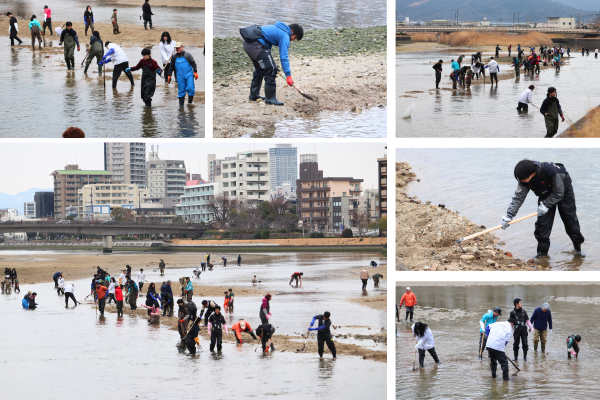
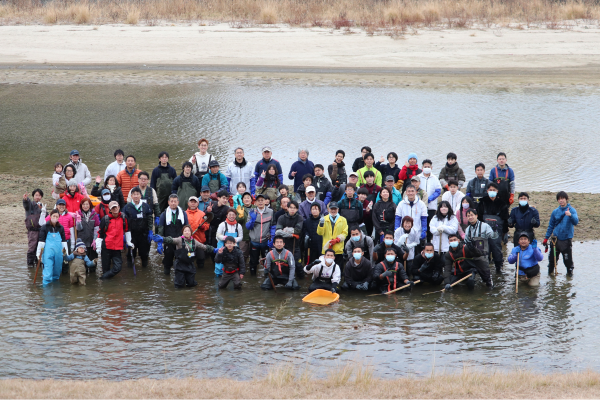
On Saturday, February 14th, the Iyooka Hiroki Laboratory of the Department of Urban Design Engineering, Faculty Faculty of Architecture and Civil Engineering Department of Civil and Urban Design Engineering, Fukuoka University, worked with local residents to carry out the Muromi River Ice Cream Spawning Ground Creation Project, which aims to improve the environment of ice cream spawning grounds along the Muromi River, which flows through Fukuoka City. Approximately 100 students and local residents participated.
The ice goat fishing industry once brightened up the spring of the Muromi River, but environmental changes in the Muromi River have led to a loss of spawning grounds, and changes in the breeding environment in Hakata Bay have led to a decline in the ice goat population, resulting in a continued suspension of fishing in recent years. This project has been ongoing for 16 years, and is based on the strong desire to "protect the ice goat, a local treasure, with our own hands," rather than simply conserving the environment.
On the day, work began at low tide, when the riverbed is revealed. Participants donned rubber boots and entered the river, then, with hoes and shovels in hand, carefully dug up stones buried under the mud and sand one by one, creating spawning grounds for ice goby, which have the habit of laying their eggs on the undersides of stones.
Participants shared a variety of impressions, including, "Environmental changes are a major issue, and through this activity, I was reminded of the importance of always thinking about what we can do to address any problem," and "I don't usually go into rivers, so the work itself was fun. Based on the lecture given by Professor Iyooka beforehand, I worked while thinking about the creatures living in the Muromi River. I hope this will have an effect."
Associate Professor Iyooka says, "The causes of the population decline involve a complex web of factors in the ocean and rivers, and are not simple to address. However, going into the river with local people like this and continuing to provide a forum for talking about the environment is the first step towards solving the problem. Through this activity, we aim to create a framework for 'citizen construction' in which citizens themselves contribute to local issues, and to reaffirm their recognition of the local community. We are working in the belief that this circle of cooperation will become an even greater force."
[Department of Civil and Urban Design Engineering]