On Tuesday, January 20th, a convenience store, a food manufacturer, and Kyushu Sangyo University co-hosted an industry-academia co-creation seminar entitled "Thinking about the Future of Food" at our university.
The seminar, with the theme of "solving social issues using new technology," introduced the latest trends in hygiene management and freshness preservation, and was attended by approximately 180 people, including students and faculty from the university, as well as representatives from companies and the local community.
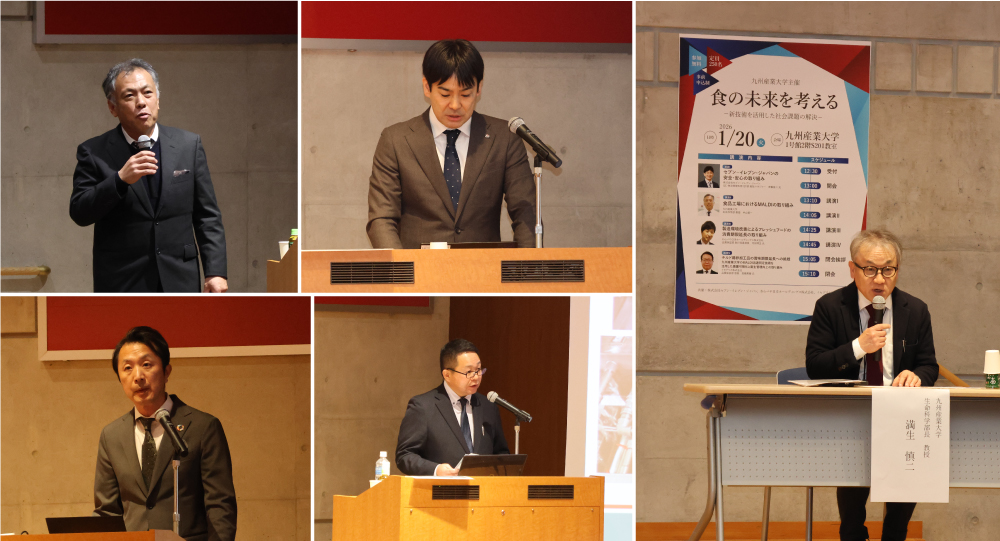
The event began with a presentation by Shunji Saito of Seven-Eleven Japan Co., Ltd. (Chiyoda-ku, Tokyo) on the company's safety and security initiatives. He introduced the current situation, in which the company has digitized HACCP * management and integrated temperature control and cleaning records with other inspection and replenishment tasks to create a hygiene management system that "continues to do the obvious things as an obvious thing" in store operations nationwide. He explained how the company is achieving both efficiency and reliability by digitizing HACCP* management and integrating temperature control and cleaning records with other inspection and replenishment tasks on tablets. He also explained the innovations that allow employees to comfortably engage in hygiene management at fresh food manufacturing sites and the improvement system that utilizes accumulated data. Students then asked questions about the specific results of these initiatives in reducing food waste, and specific examples were presented, such as flexible expiration dates and improved expiration date labeling based on product characteristics.
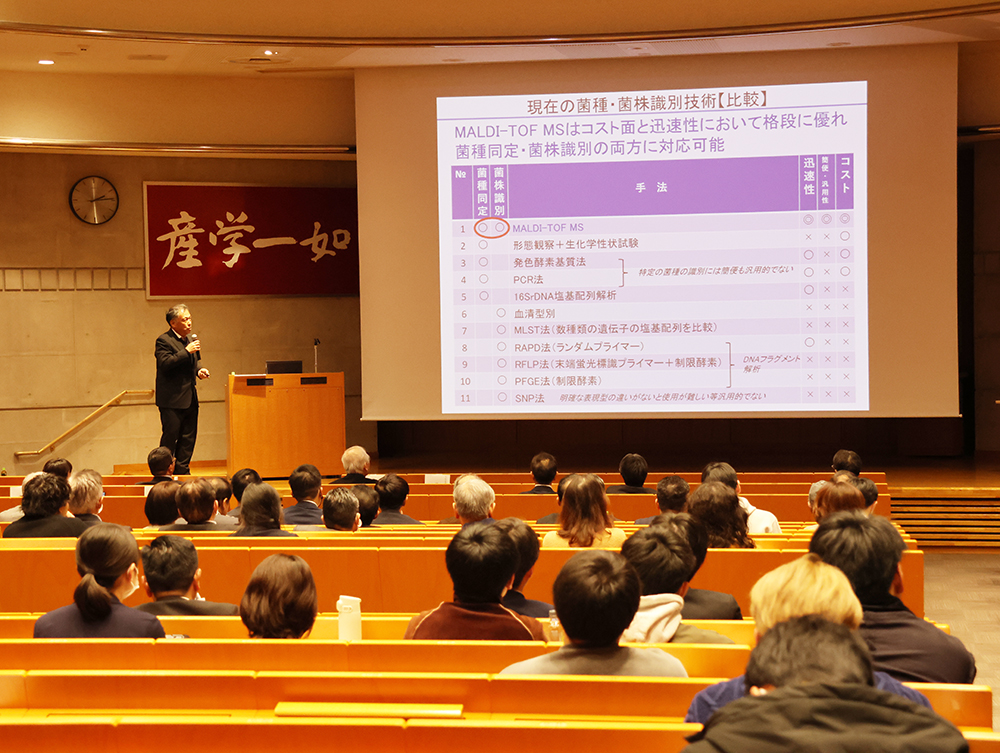
続いて、生命科学部生命科学科中山素一教授が、内閣府「第7回オープンイノベーション大賞」を受賞したMALDI(以下、マルディー)を活用した菌種の迅速同定技術を紹介。微生物の特徴を質量分析で可視化し短時間で判定できることが、食品工場における衛生管理高度化に有効であり、食品産業へのマルディーによる同定の普及を目的とした産学官協働の微生物同定コンソーシアムの取り組みなどを共有しました。
最後に、導入事例として、わらべや日洋ホールディングス株式会社(東京都新宿区)より、マルディーによる同定実施状況が報告されました。主力商品の一つである「味しみロースかつ丼」を対象に、製品から検出された乳酸菌がどの工程で混入しているかを特定、製造機械の線情報の改善などによって衛生管理の向上と賞味期限延長につながった成果を発表しました。さらに、イセデリカ株式会社(茨城県龍ケ崎市)からは、玉子フィリングの製造工程におけるマルディー菌種同定により、工程ごとの菌叢を可視化、影響箇所を特定したことで従業員の洗浄意識が向上し、賞味期限延長に向けた取り組みが本格的に開始されたことが報告されました。
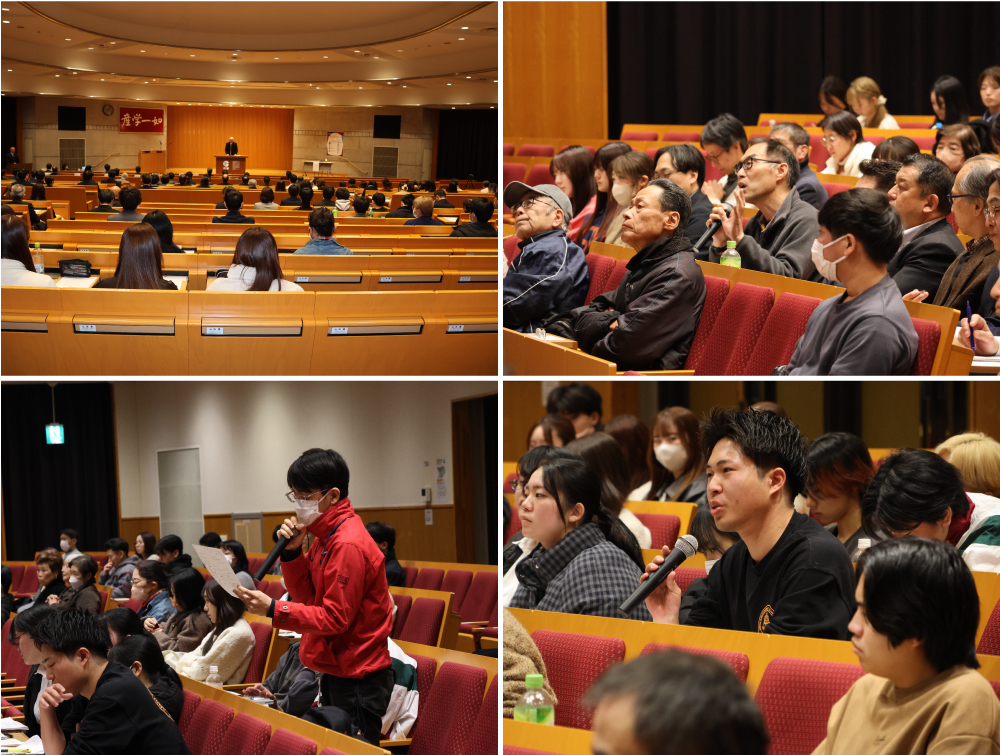
Some of the participating students and members of the public were seen taking notes enthusiastically as they learned about corporate hygiene management, information they don't normally come across, and they asked active questions after each explanation. In closing, Mr. Saito said, "It was a valuable opportunity for companies, researchers, and users to come together in one place. We were able to make new discoveries by receiving questions from the user's perspective, not just the company's, and it was a very meaningful event."
After the event, Ise Delica Co., Ltd. distributed some of their products as souvenirs, providing an opportunity to connect what was learned in the lecture with actual products, which was well received by local residents and students.
Our university will continue to promote industry-academia-government co-creation and contribute to creating a safe and secure food environment in society.
*HACCP: Hazard Analysis and Critical Control Point. A hygiene management method to ensure food safety by analyzing hazards (microbial contamination, foreign matter contamination, temperature deviation, etc.) at each process from receiving raw materials to manufacturing, cooking, and shipping, and by setting particularly important control points and continuously monitoring, recording, and correcting them. As of June 1, 2021, all food business operators (manufacturing, processing, cooking, sales, etc.) are required to implement hygiene management in accordance with HACCP.
[Industry-Academia Co-innovation and Research Promotion Headquarters / Faculty of Life Science]