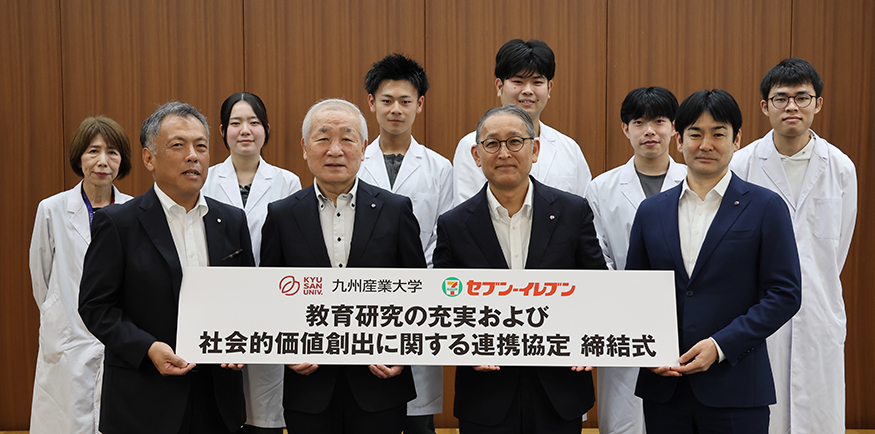
On Thursday, July 2nd, our university became the first university in Kyushu to sign a cooperation agreement with Seven-Eleven Japan Co., Ltd. (Tokyo).
This agreement will promote collaborative research, student education, and social collaboration activities, starting from the research area of Professor Motoichi Nakayama of Faculty of Life Science, Department of Life Science, with the aim of continuous and interdisciplinary academic advancement and human resource development. In particular, it will promote industry-academia collaboration aimed at reducing food waste and ensuring food safety and security, focusing on the microbial identification technology using MALDI, which Professor Nakayama's group won the Minister of Agriculture, Forestry and Fisheries Award at the 7th Japan Open Innovation Awards in 2025, and address social issues.
To date, our university, led by Professor Nakayama, has collaborated with companies that manufacture products for the company, conducting joint research on extending the freshness of prepared food products (such as katsudon and onigiri) through microbiome analysis using MALDI. This research has resulted in extending shelf life, improving delivery efficiency, and contributing to the reduction of food waste.
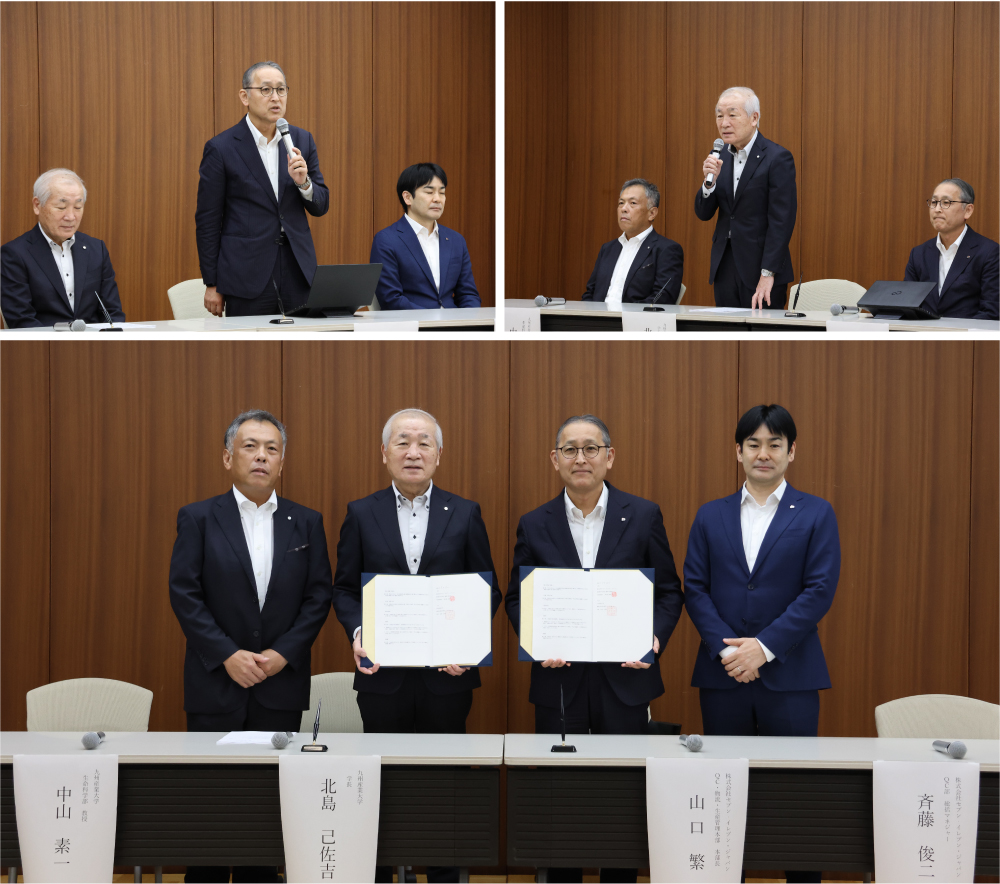
At the signing ceremony, Shigeru Yamaguchi, Executive Officer and General Manager of the QC, Logistics, and Production Management Division at Seven-Eleven Japan Co., Ltd., introduced the business foundation of Seven-Eleven, which operates approximately 21,000 stores in Japan and is used by approximately 20 million people daily. Regarding the company's flagship product, original fresh food, he said, "Food waste is a significant issue. In this initiative, we have been able to extend the shelf life by reviewing the manufacturing process without relying on additives, and by adjusting the number of production and delivery cycles, we have been able to reduce food waste throughout the entire supply chain. We will continue to work to solve social issues while staying close to our local customers."
President Kitajima stated, "This agreement is a practical and socially valuable initiative. We expect it to yield results that directly contribute to solving social issues such as reducing food waste and ensuring food safety and security. By developing our previous individual research collaborations into a systematic partnership, we will enhance educational opportunities. By combining university knowledge with the practical capabilities of companies, our university will approach this with a strong sense of mission and aim to further contribute to the formation of research bases and the industrial sector. We hope that this collaboration will become an advanced model for solving social issues through industry-academia collaboration."
Going forward, based on this agreement, we will further develop research on improving hygiene management and extending the freshness of products, as well as implement multifaceted industry-academia collaborations, including enriching educational programs such as lectures, site visits, and internships on the theme of "food safety and security," and disseminating information to local communities.
[Faculty of Life Science / Industry-Academia Co-innovation and Research Promotion Headquarters]