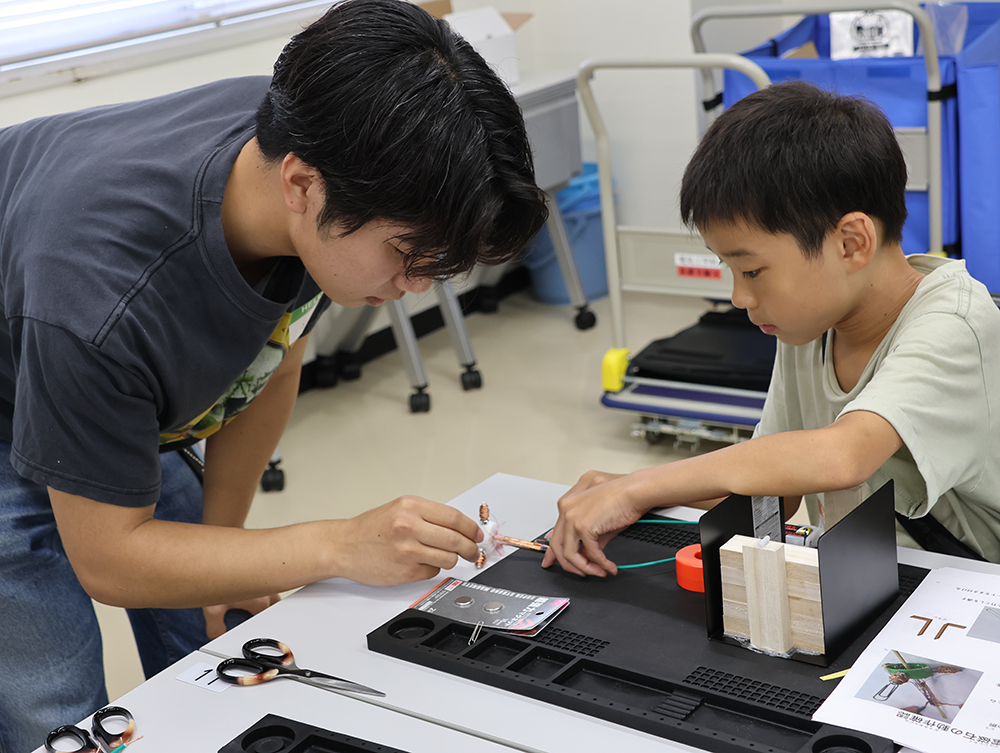
On Wednesday, August 5th, seven third and fourth-year students from the Department of Department of Electrical Engineering, Faculty of Science and Faculty of Science and Engineering, held the "2026 Children's Science Workshop: Let's Learn About the Mechanism of a Three-Pole Motor!", which was attended by 22 elementary school students. This workshop was organized and supervised by the Kyushu Branch of the Institute of Electronics, Information and Communication Engineers, and supported by the Children's Dream Fund (National Institute for Youth Education), and was conducted as part of the department's course "Project Design Management".
In this course, with the aim of conveying the fun of science and making things to elementary school students, students took the lead in planning and preparing everything from considering production themes and selecting materials to creating explanatory materials and posters, and planning the operation of the day, while considering how to explain things in an easy-to-understand way using their specialized knowledge.
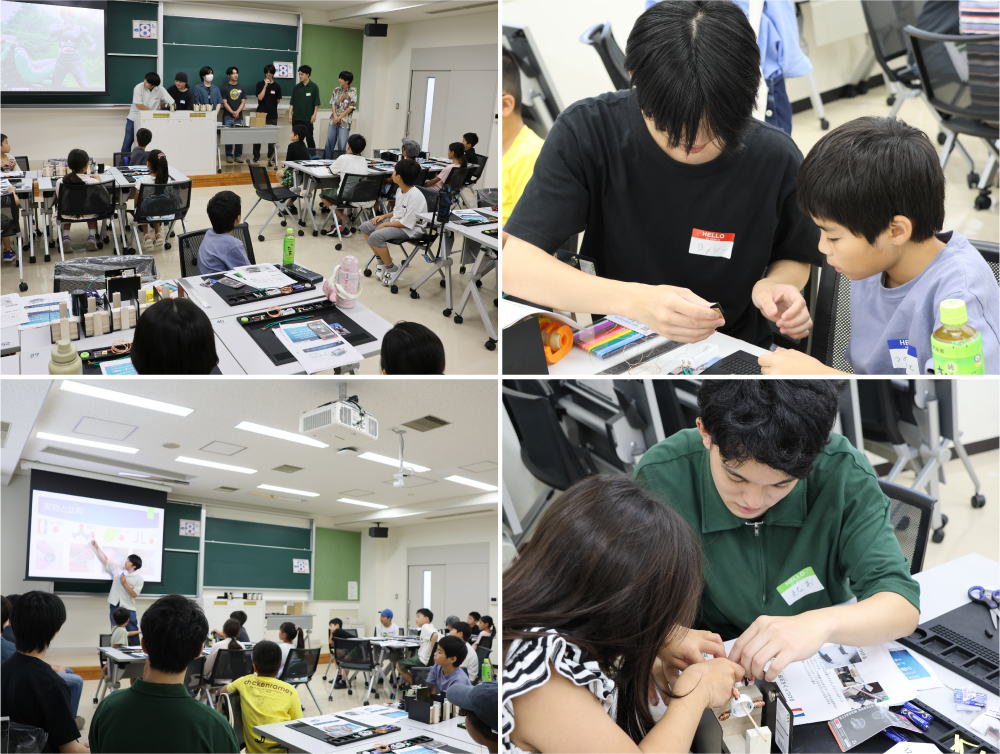
On the day of the event, following student self-introductions, the students gave a general explanation using slides they had created, explaining "What is a motor?" They introduced that a motor is a component that rotates when electricity is applied, and then used a quiz format to explain how motors are used in everyday products.
In the craft activity, the children created a three-pole motor using materials purchased from a 100-yen shop and plastic bottle caps. With the support of the students, the participating children tackled detailed tasks such as sanding enamel wire, winding coils, and assembling parts.
Haruto Uchida (Fukuoka Maizuru High School), a fourth-year student in the same department who was in charge of overall coordination, said, "We wanted to let the children know how fun it is to make things using everyday materials, so we used clips, bookends, and plastic bottle caps. We also created materials with many diagrams so that even elementary school students could easily understand them, and we tried to convey difficult content through images rather than forcing explanations. I was happy that the children actively asked questions about things they didn't understand. On the other hand, there were times when the production process was complex and they struggled, so I realized the importance of creating easier-to-understand teaching materials. I would like to use this experience in my future learning and activities."
This initiative provided a meaningful opportunity for students to give back to the local community the knowledge and skills they have cultivated in their classes, while also fostering children's interest in science and manufacturing.
[Department of Electrical Engineering]