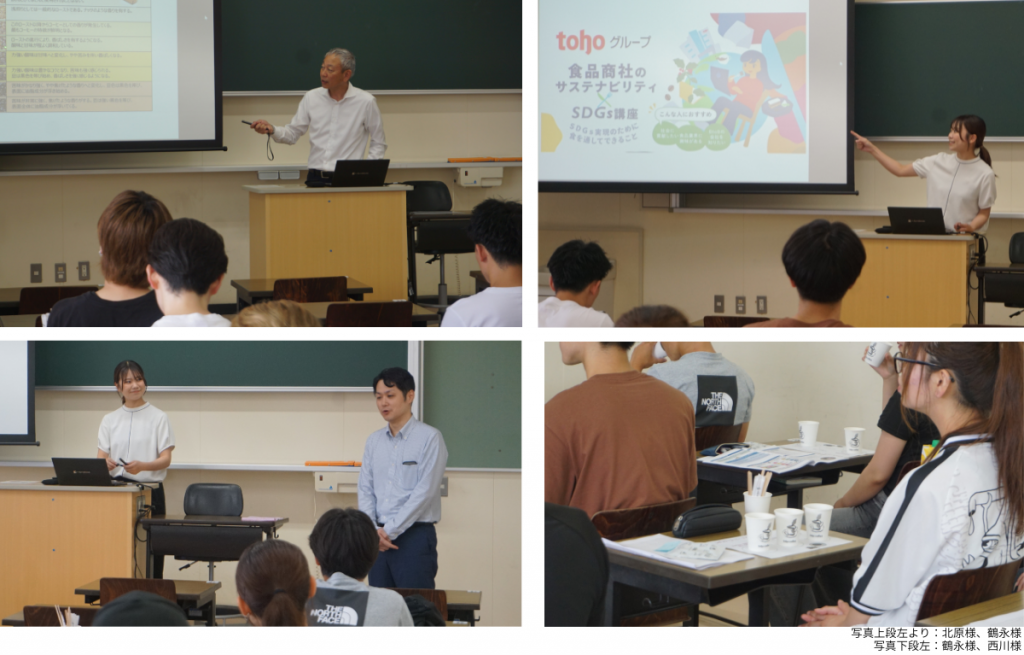
On Monday, July 6th, Associate Professor Koichi Kuroki of the Department Faculty of Economics, Department of Economics hosted a lecture entitled "Sustainability SDGsSeminar for Food Trading Companies - What We Can Do Through Food to Achieve the SDGs -" in his course "Practical Planning Seminar I". The guest speakers wereMs. Riu Tsurunaga (Human Resources Department) and Mr. Mitsuhiro Kitahara (Coffee Department) from Toho Co., Ltd. (Headquarters: Kobe City), and Mr. Masayuki Nishikawa (Human Resources Department), an alumnus ofthis university.
In the lecture, Mr. Tsurunaga first explained the overview of the wholesale food industry for commercial use and the business activities of the Toho Group. Following that,JCQACertified Coffee Instructor1class *1 andSCAJCoffee Master *2 Mr. Kitahara, who holds the relevant qualifications, spoke about trends in the Japanese coffee market, the current situation surrounding coffee production, and the so-called "coffee" impact of climate change.2050The presentation included specific examples and discussions on topics such as the "annual problem" and activities to promote fair trade products.
Furthermore, it was a valuable opportunity to deepen our understanding of the role that companies play in realizing a sustainable society, including the relationship between corporate activities andthe SDGs. In addition, it was shown that not only corporate behavior but also consumer behavior is important in realizing a sustainable society, and we learned about the concept of "ethical consumption *3," which involves choosing products and services that take the environment, society, and human rights into consideration.
On the day of the event, students also had the opportunity to sample the fair trade coffee that the company handles. While tasting the products, the students learned how fair trade contributes to improving the lives of producers and supporting sustainable production activities. By connecting the lecture content with the product experience, it became an opportunity to deepen their understanding of sustainability and ethical consumption.
The students listened attentively to how companies balance solving social issues with their business activities. During the Q&A session after the lecture, Mr. Nishikawa joined in, and the students, coffee in hand, asked questions, creating a friendly atmosphere as the event concluded.
In this course, we plan to work on planning events in the third and fourth quarters that focus on solving local issues and revitalizing local communities. Furthermore, we plan to implement the plans we have developed in the advanced course "Practical Project Planning Exercise II," which is scheduled to begin next year. The sustainability perspective, the concept of collaboration with local communities, the promotion of fair trade products, and the importance of ethical consumption *3 that we learned through this lecture are expected to provide important hints for our future studies.
*1 A certification system recognized by the All Japan Coffee Examination Committee that certifies proficiency in everything from the basics of coffee to specialized knowledge and appraisal techniques.
*2 A professional certification program recognized by the Specialty Coffee Association of Japan.
*3 This refers to "ethical consumption," which means making purchases that contribute to solving social problems.
[Faculty of Economics]