Faculty of Architecture and Civil Engineering
Department of Architecture

architectural design competition

ABOUT
Department of Architecture
In response to the challenges posed by society,
We pursue architecture that provides the "answer."
- #people
- #architecture
- #design
- # Disaster prevention and earthquake resistance
- #Environmental architecture
- #design
- #Practical

ADMISSION
POLICY
- 01
Architectural design and planning, architectural history and design, architectural structure, materials and construction methods,
People with a strong desire to learn about building environment and facilities, and urban planning. - 02
Identify the problem, consider it from multiple perspectives, and organize your own thoughts.
A person who can express themselves in collaboration with others. - 03
Students proactively engage in advanced learning and practical challenges.
In the future, through advanced subjects, etc.
People who are motivated to further enhance their expertise
Characteristics of the Department
The best in Kyushu
Practical Architectural Education
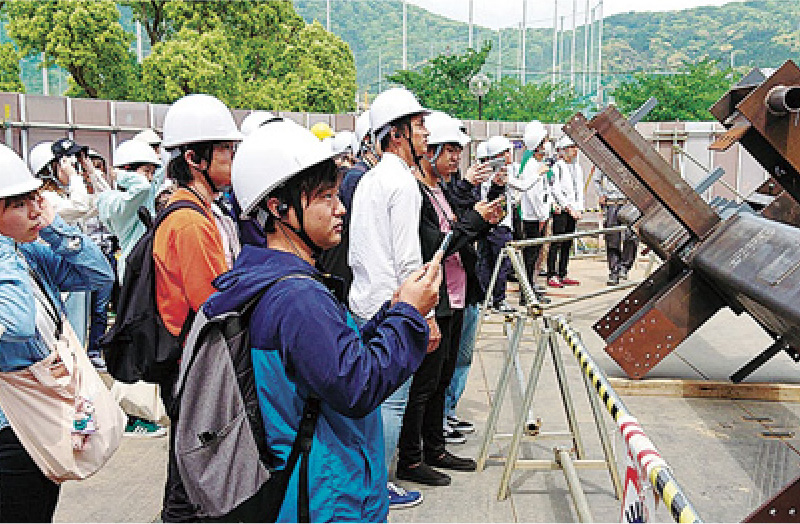
This is Kyushu's premier practical architectural education center, offering comprehensive learning in three areas: "Planning and History," "Environment and Facilities," and "Structure and Production." It boasts a high employment rate and track record in the construction industry.
From Kyushu to the world,
Global architectural talent
We have set up courses that teach English expressions for specialized knowledge. We also conduct exchange activities with universities overseas. We are cultivating global architectural talent that can be used internationally.

The fundamentals I learned at university
Practical skills outside of school
In addition to class assignments and other regular curricular activities, students are learning practical architectural design methods outside of school by participating in workshops both in Japan and overseas, and providing support through architecture in disaster-stricken areas.

Advanced Program
A support program that responds to motivation
Practical Architectural Skills Training Program
[ABC Architecture Dojo]
This school is aimed at highly motivated and ambitious students, and through advanced, practical education, they will acquire architectural skills accompanied by high levels of technique.
Four-year learning process
Building a foundation for learningin the first year
Using the home, the origin of architecture, as a subject, students will build a foundation for learning architecture through hands-on learning that involves "seeing, touching, and building."
Building a foundation for specialized learningin the second year
Students will study in the fields of "Planning and History," "Environment and Facilities," and "Structure and Production."
Third-year studentsselect and study their specialized field.
Students will join a laboratory that matches their aptitude and learn in depth the techniques that correspond to their field of expertise.
4th yearFor the future (employment/further education)
Activities toward
Activities toward
As a culmination of their studies, students will work on a graduation thesis or graduation project.
Class Pickup
Understanding the essence of steel structure from a historical perspective,
Learn about the evolution of technology
Steel frame structure
Professor Yuko Kang
30-40% of buildings in Japan are constructed with steel frames (steel structures). More than 100 years have passed since steel-frame buildings began to be constructed, and technology, such as the development of new steel materials and structural systems, is advancing every day. For students studying architecture, it is one of the basic subjects, along with "reinforced concrete structures" and "timber structures," and it is also a subject that is easy to understand in relation to "structural mechanics." We will learn in the clearest way possible, reviewing history and incorporating the latest materials, construction methods, and analysis methods, along with practical exercises, so that you can understand the essence of the principles and theories that form the basis of design.

Advanced technologies that emerged from the mid-18th century to the 20th century
Focus on architectural features
modern architectural history
Professor Hideo Tomita
Architectural history is the study of the history of architecture from ancient times to the present. In Department of Architecture, you can learn about the history of Japanese architecture, Western architecture, and modern architecture. Modern architecture in particular is the foundation of the general architecture that surrounds us today. For this reason, "Modern Architectural History," which studies how modern architecture was shaped, is an essential study for a deeper understanding of contemporary architecture. In "Modern Architectural History" classes, we focus on the characteristics of the shapes, colors, materials, and ideas of advanced architecture that emerged from roughly the mid-18th century to the 20th century.

Seminar Pickup
Tomoko Ohba Seminar
Starting with an empty house,
A new chapter in community service
Our laboratory tackles social issues through the "renovation and utilization of vacant houses." We study the impact of architecture on local communities, focusing on various buildings such as shared houses, guest houses, and welfare facilities. Our research is based on fieldwork, and also utilizes GIS and statistical analysis. We aim to contribute to the community through practical learning.

Seminar student voices
Kanon Mizutani
Chikuzen High School/Fukuoka

This research lab focuses on the theme of children's cafeterias utilizing vacant houses, exploring the potential of architecture to address local issues. Through surveys and analyses, it provides a practical environment for learning about the role architecture plays in society. This lab is recommended for those who want to learn about architecture that is closely connected to the local community.
Yuko Kuma Seminar
Is that house really comfortable?
Try it, measure it and decide for yourself!
We live in an age where a "home that is warm in winter and cool in summer" is the norm. In this seminar, we will further incorporate natural energy to realize a living environment that is highly comfortable and energy-efficient. We will acquire high-level skills and expertise while learning and thinking on our own about how architecture is related to social issues such as the SDGs and decarbonization.

Seminar student voices
Nozomi Ikegami
Shimabara Technical High School/Nagasaki

I'm involved in the development of whole-house air conditioning systems and conduct research on residential comfort and energy conservation. The appeal of the research lab is that you can see, touch, and learn in depth from actual homes where the systems have been installed!
Xu Yuanyu Seminar
Starting from the materials,
Sustainable forms of architecture
Global warming has become an unavoidable challenge, and realistic responses are required. In this laboratory, we study how building structural materials are related to global warming and how their environmental impact can be reduced. In this seminar, we are examining the effects of global warming on the strength and durability of concrete through experiments recently conducted in Vietnam. In this way, we are also conducting international collaborative research with countries such as Vietnam and South Korea.

Seminar student voices
Aoto Nakano
Kagoshima Technical High School / Kagoshima

This research lab addresses global warming from a materials perspective and teaches about sustainable architecture. I also participated in an experiment in Vietnam, which gave me valuable experience learning about overseas construction sites and diverse types of buildings!
Qualifications and career path data
Qualifications to aim for
- First class architect
- Second class architect
- Concrete Technician/Senior Concrete Technician (Practical experience required)
- Building Equipment Engineer (Requires 2 years of practical experience)
- Architectural Construction Management Engineer (Level 1 & 2, practical experience required)
- Real Estate Transaction Specialist
- High School Teacher's License (Industrial Arts)
- Curator
- Social education specialist (training course), etc.
Main Employment Destinations
- Taisei Corporation
- /(株)大林組
- Shimizu Construction Co., Ltd.
- Takenaka Corporation
- Penta-Ocean Construction Co., Ltd.
- Ando Corporation
- Maeda Construction Co., Ltd.
- / Toda Construction Co., Ltd.
- Mitsui Sumitomo Construction Co., Ltd.
- Nishimatsu Construction Co., Ltd.
- Zenko Gumi Co., Ltd.
- Matsuo Construction Co., Ltd.
- Uemura Construction Co., Ltd.
- Takasago Thermal Engineering Co., Ltd.
- Craftia Co., Ltd. (formerly Kyushu Electric Power Co., Inc.)
- Sanki Engineering Co., Ltd.
- Taikisha Co., Ltd.
- / Shin Nippon Air Conditioning Co., Ltd.
- Daidan Corporation
- / Shinryo Reinetsu Kogyo Co., Ltd.
- Sekisui House Co., Ltd.
- Daiwa House Industry Co., Ltd.
- Mitsui Home Co., Ltd.
- /Ichijo Construction Co., Ltd.
- Sumitomo Forestry Co., Ltd.
- / Misawa Homes Kyushu Co., Ltd.
- Daito Kentaku Co., Ltd.
- Kajima Building Management Co., Ltd.
- West Japan Railway Company
- NTT Facilities, Inc.
- / Kengo Kuma Architects and Urban Design Office Co., Ltd.
- / Nikki Sekkei Co., Ltd.
- Hirate Giken Co., Ltd.
- / Tato Architects / Yo Shimada Architects
- SUEP Co., Ltd.
- / NKS2 Architects
- Saga Prefecture (High School Teacher, Industrial Arts)
Graduate Interview
松田 颯佑さん
大分工業高校 / 大分
- Employment
- XYZ structure 一級建築士事務所
実家が造園業を営んでおり、「形あるものがつくられていく現場」を身近に感じて育ったことが、建築を志す原点となりました。在学中は、既存の設計手法にとらわれない、新たな建築のルールづくりに注力しました。頭の中にある抽象的な法則を即座に視覚化できるデジタルツールを活用しながら、アナログの手法も取り入れ、建築の多様な可能性を探求しました。「空間構成演習」という授業をきっかけに、構造設計の自由さと面白さを知り、その道に進むことを決意しました。将来は現場経験を重ね、構造にとどまらず、意匠や外構、インテリアまで幅広く関わる建築に携わりたいと考えています。

野見山 耕成さん
新宮高校 / 福岡
- Employment
- 株式会社大林組 建築系(建築施工)
小さい頃からものづくりが好きで、建築に興味を持ったことをきっかけに、この道へ進みました。大学時代に特に力を入れたのは、イタリアの古典主義建築に関する研究です。歴史的建築に込められた思想や意匠を読み解くことで、建築の魅力と奥深さを学びました。先生方の言葉の中で特に印象に残っているのは、「目の前のことから逃げずに継続すること」です。卒業後は株式会社大林組に入社し、建築現場での施工管理に携わる予定です。さまざまなプロジェクトに向き合う中で「継続」と「実行」を大切にし、周囲から信頼される人材として、建築の現場で活躍していきたいと考えています。

Momoka Maeda
Chikushi High School / Fukuoka
- Employment
- Sumitomo Forestry Co., Ltd.
What I realized while going through the job hunting process was the importance of finding out "what I value most in the workplace." However, I think that even more important is the "preparation" before starting the job hunting process. During my university life, I actively participated in club activities, extracurricular activities, and part-time jobs, creating my own unique "student activities" to highlight. These experiences became a great asset when writing application forms and talking about them in interviews, and also boosted my confidence.


If you cannot view PDF files, please download Adobe Reader.